


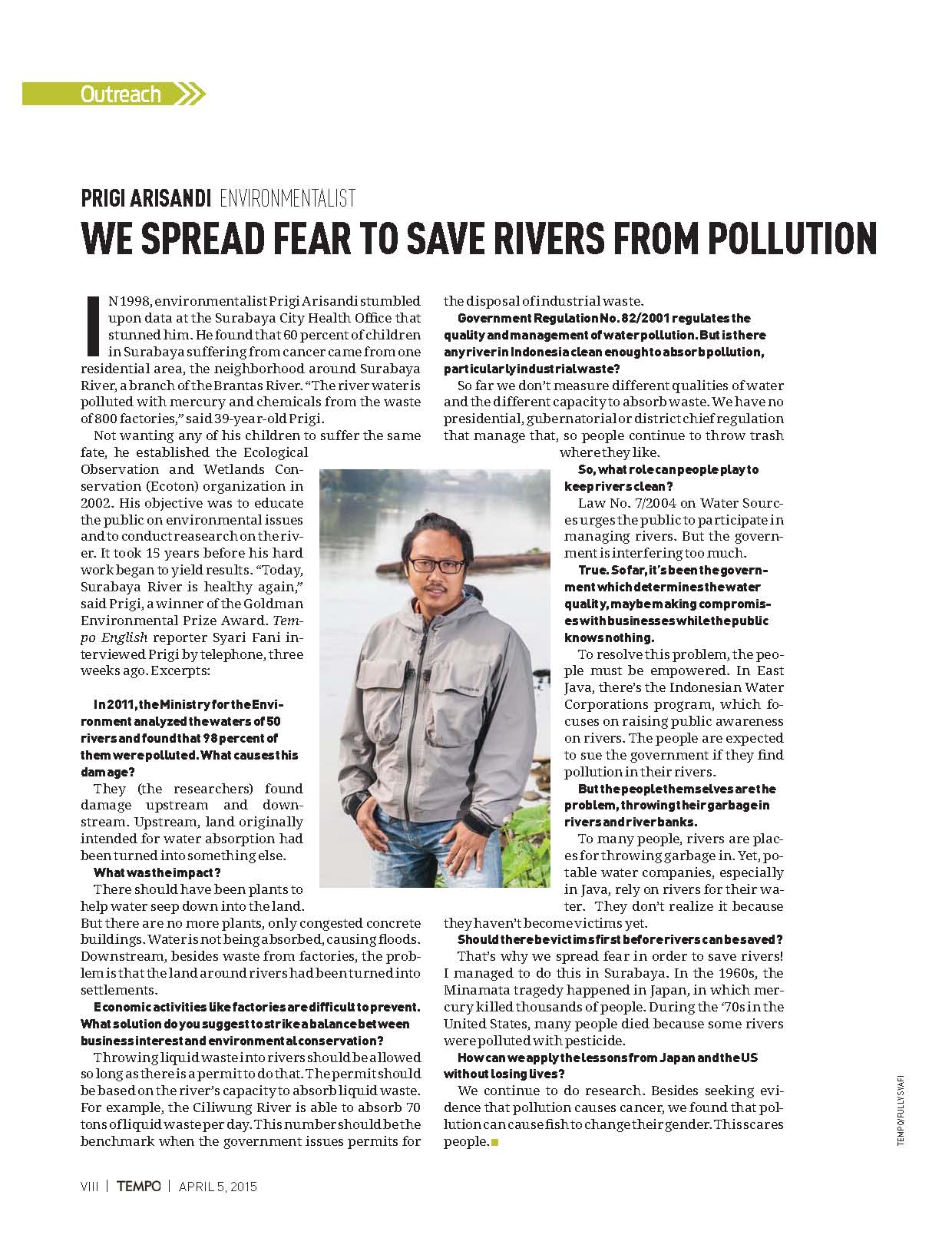
We spread fear to save rivers from pollution
In 1998, environmentalist Prigi Arisiandi stumbled upon data at the Surabaya City Health Office that stunned him. He found that 60 percent of children in Surabaya suffering from cancer came from one residential area, the neighborhood around Surabaya River, a branch od the Brantas River. “ The river wateris polluted with mercury and chemicals from the waste of 800 factories,”said 39- year-old Prigi.
Not wanting any of his children to surfer the same fate, he established the Ecological Observation and Wetlands Conversation ( Ecoton) organization in 2002. His objective was to educate the public on environmental issues and to conduct research on the river. It took 15 years before his hard work began to yield results. “Today, Surabaya River is healthy again,”said Prigi, a winner of the Goldman Environmental Prize Award. Temp English reporter Sayri Fani in-terviewed Prigi by telephone, three weeks ago. Excerpts:
In 2011, the Ministry for the Environment analyzed the waters 0f 50 rivers and found that 98 percent of them werepolluted. What causes thus damage ?
They ( the researchrs) found damge upstream and down- stream absorption had been turned into something else.
What was the impact ?
There should have been plants to help water seep down into the land. But there are no more plants, only congested concrete buildings. Water is not beings absorbed, causing floods,downstream, besides waste from factories, the problem is that the land around rivers had been turned into settlements.
Economic activities like factories are difficult to prevent. What solution do you suggest to strike a balance between business interest and environmental conversation ?
Throwing liquid waste into rivers should be allowed so long as there is a permitto do that. The permit should be based on the river’s capacity to absorb liquid waste. For example, the Ciliwung River is able to absorb 70 tons ofliquid wasteper day. This number should be the benchmark when the government issues permits for the disposal of industrial waste.
Government Regulation no.82/2001 regulates the quality and management of waterpollotiun. But is there anyriver in Indonesia clean enough to absorb pollution, particularly industrial waste ?
So far we don’t measure different qualities of water and the different capacity to absorb waste. We have no presidential, gubernatorialor or district chief regulation that manage that, so people continue to throw trash where they like.
So, what role can people play to keep river clean ?
Law No. 7/2004 on Water Sourcesurges the public to participate in managing rivers. But the government is interfering too much.
True. Sofar, it’s been the government which determines the water quality, maybe making compromises with businesses while thw public know nothing.
To resolve this problem, the people must be empowered. In East Java, there’s the Indonesian Water Corporations program, which focuses on raising public awareness on rivers. The people are expected to sue the government if they find pollution in their rivers.
But the people them selves are the problem, throwing their garbage in rivers and river banks.
That’s why we spread fear in order to save rivers ! I managed to do this in Surabaya. In the 1960s, the Mina mata tragedy happened in Japan, in which mercury killed thousands of people. During the ‘70s in the United States, many people died because somerivers were polluted with pesticide.
How can we apply the lessons from Japan and the US without losing lives ?
We continue to do research. Besides seeking evidence that pollution causes cancer, we found that pollution can cause fish to change their gender. This scares people.
Sumber: Tempo: April 5,2015