


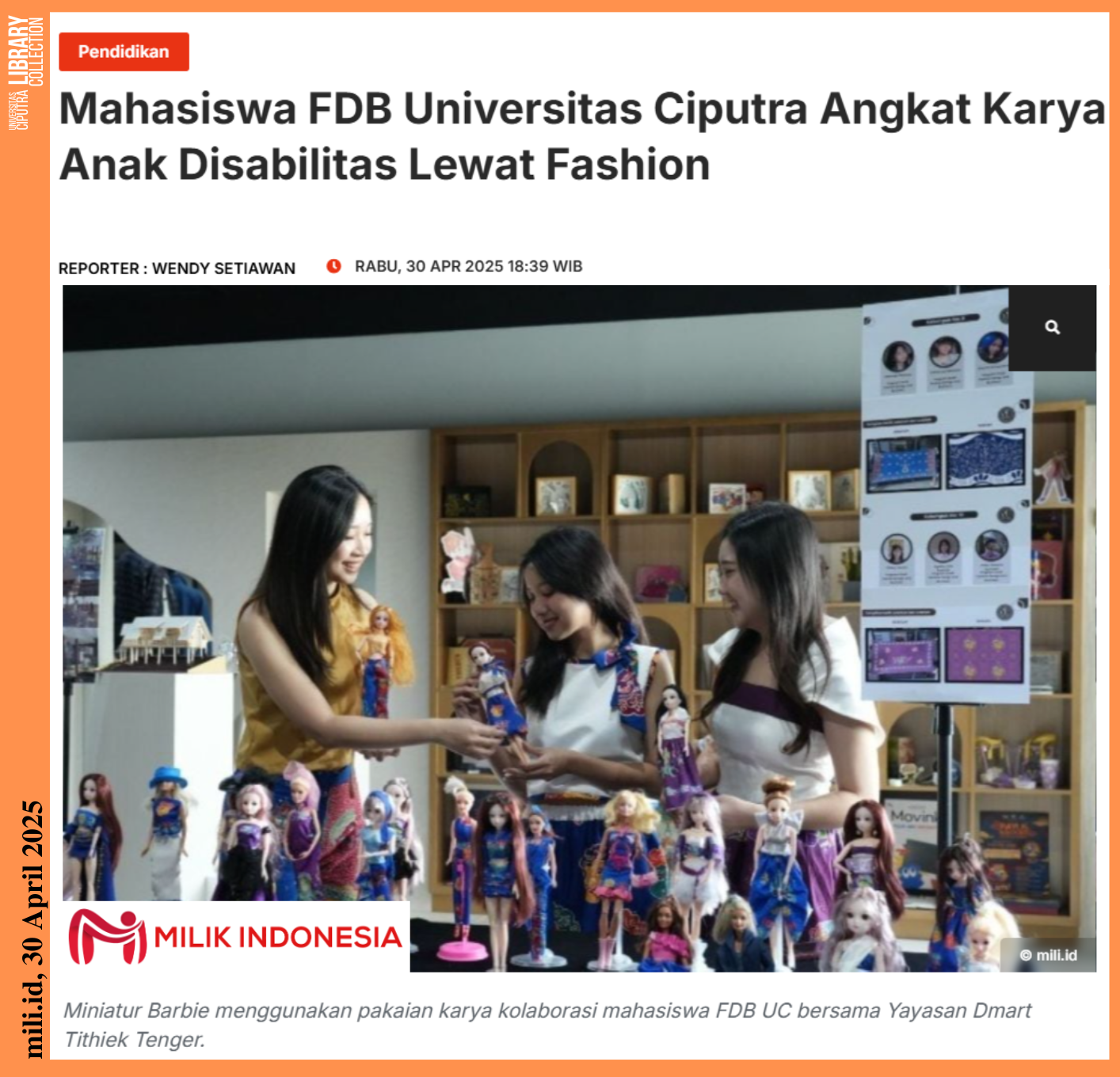
Ciputra University’s FDB students showcase the work of children with disabilities through fashion.
Surabaya, mili.id – FDB Students of Ciputra University Promote the Work of Children with Disabilities Through Contemporary Fashion – Fashion Design and Business (FDB) students of Ciputra University (UC) together with the Dmart Tithiek Tenger Foundation, a social organization that supports children with special needs in Malang City, collaborated to create contemporary artwork, Wednesday (30/4/2025).
This project began with concern for the artisanal batik work of Topeng Malangan, created by disabled batik artisans from the Dmart Tithiek Tenger Foundation, which was deemed to have low market value, be less competitive, and not meet the tastes of today’s youth market.
Janet Teowarang, the project’s supervisor, explained that she subsequently purchased three batik fabrics with different motifs, created by disabled batik artisans, for use in contemporary fashion designs.
“The initial steps were simple: the contemporary fashion design process involved transferring 2.5 x 1.20 meter batik fabrics into digital data using a scanner,” she said.
“Then, the batik fabrics were scaled down and printed with eco-friendly inks to create clothing for Barbie dolls, drawing inspiration from modernised world fashion history,” she continued.
Janet explained that this process was part of an exploration in her Fashion and Culture course, intended to address social issues of inclusion through design and culture.
“From these miniature creations, concrete interpretations emerged in the form of three stunning fashion collections,” she added.
The first piece by Vallysha Christian Happy and Jennifer Christella Wijaya drew inspiration from feminine styles of the 1940s–1950s, featuring classic A-line silhouettes, high-collared white tops with sleeves, and elegant accessories.
“This piece combines cultural values with a classic and classy vintage aesthetic,” she explained.
Meanwhile, the second piece by Gusti Agung Istri Krisna Kirana Kepakisan and Audriana Clarissa explored batik in the spirit of the 1970s, featuring colourful and bohemian influences.
They presented flare-leg pants in batik fabric and halter tops with long ribbons that hung down to the floor. They combined the bright, contemporary batik iconic of Malang City, featuring the psychedelic colours of the 1970s, with a modern ethnic style.
The third piece by Rebecca Hagia Pranoto and Melanie Gunawan Puteri drew inspiration from the typical silhouettes of women’s fashion from the 1950s–1960s, where the full skirt was a key feature.
“The skirt was modernised into a balloon skirt shape that retains the distinctive volume of the 50s, but with a more playful and dynamic cut,” she explained.
For the top, they chose a sleeveless model with a simple cut, combined with a ribbon accent at the neckline for a feminine touch typical of the 1960s.
The vintage feel is enhanced by modern batik motifs woven into the ribbon and collar details, and by the predominance of traditional mask motifs on the skirt, which highlight local cultural values.
The students went beyond clothing; they also redesigned existing batik motifs, reinventing them to suit young tastes.
“We hope that the batik motifs created by these young artisans with disabilities will be more attractive, more vibrant, and more appealing to the younger generation, who may have previously been untouched by traditional batik from the disabled community,” she said.
Djoko Rendy, the Chair of the Foundation, expressed pride in collaborating with students from Ciputra University Surabaya in the redesign of Batik Topeng Malang.
“Through this collaboration, our friends with disabilities from DMart gained valuable experience interacting, learning, and contributing to a major project that elevates local culture,” he said.
One of the disabled artisans, Dimas Rachmadhani, considered the collaborative batik designs extraordinary. “I found the batik designs incredibly beautiful. My favourites are the batik designs from groups 1 and 2. I love the colours and motifs,” he concluded.