


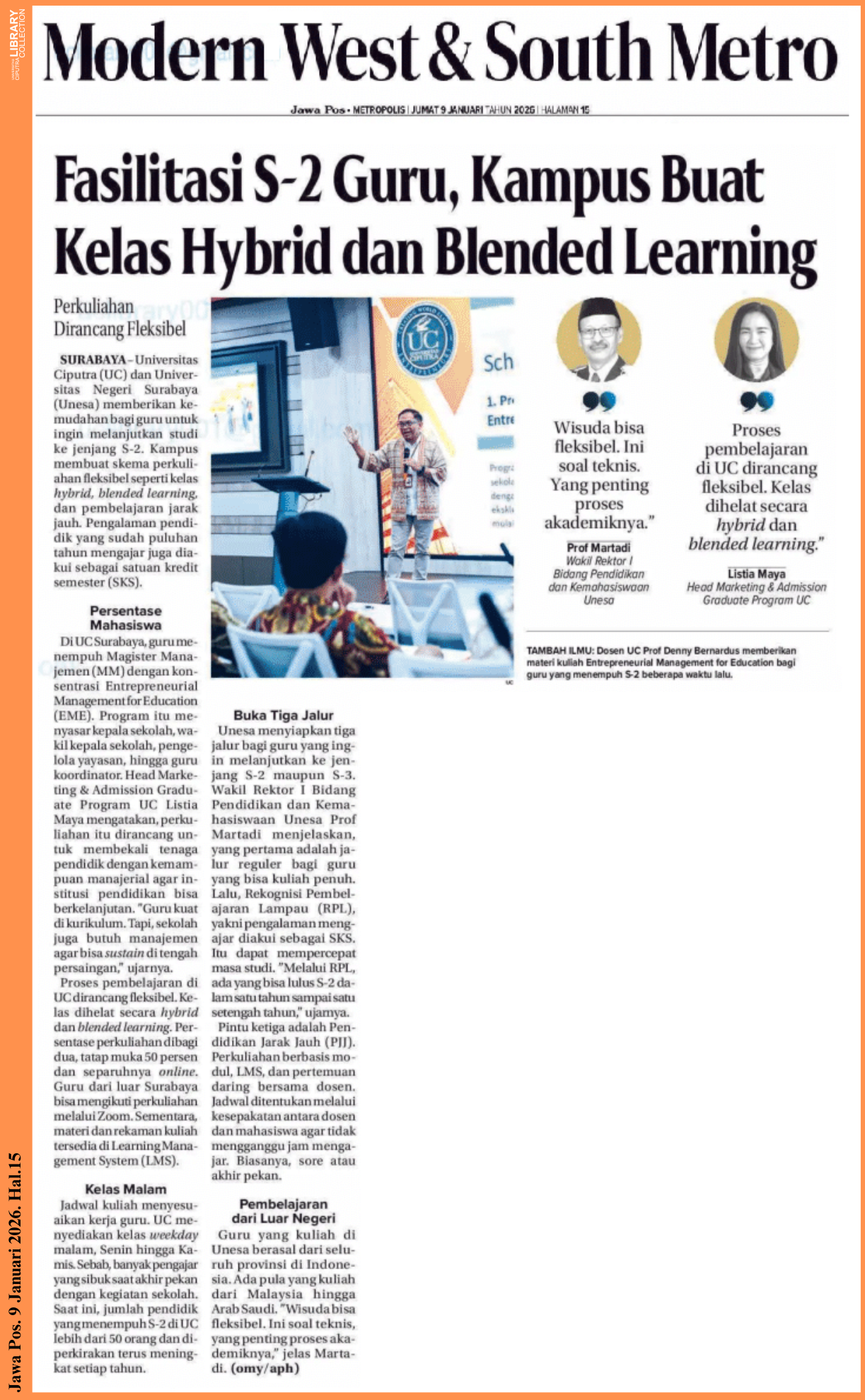
Master’s Program Facilities for Teachers: Campuses Create Hybrid and Blended Learning Classes. Lectures Designed to Be Flexible.
January 9, 2026
Ciputra University (UC) and Surabaya State University (UNESA) are making it easier for teachers to pursue master’s degrees. The universities have created flexible learning schemes, including hybrid classes, blended learning, and distance learning. Decades of teaching experience are also recognized as semester credit units (SKS) for teachers.
Student Percentage
At UC Surabaya, teachers are pursuing a Master of Management (MM) with a concentration in Entrepreneurial Management for Education (EME). The program targets principals, vice principals, foundation managers, and teacher coordinators. Listia Maya, Head of Marketing & Admission for the UC Graduate Program, said the program is designed to equip educators with managerial skills to ensure the sustainability of educational institutions. Teachers are strong in the curriculum. But schools also need management to sustain a competitive environment,” she said.
The learning process at UC is designed to be flexible. Classes are held using hybrid and blended learning. Lectures are split into 50 per cent face-to-face sessions and 50 per cent online sessions. Teachers from outside Surabaya can attend lectures via Zoom. Lecture materials and recordings are available on the Learning Management System (LMS).
Evening Classes
The class schedule is tailored to teachers’ workloads. UC offers weekday evening classes, Monday through Thursday, as many teachers are busy on weekends with school activities. Currently, the number of educators pursuing Master’s degrees at UC is more than 50 people and is expected to continue to increase every year.
Open Three Pathways
Unesa (Unesa) offers three pathways for teachers who wish to pursue a Master’s or Doctoral degree. Prof. Martadi, Vice Rector I for Education and Student Affairs, explained that the first is the regular pathway for teachers who can attend full-time. Then, there’s Recognition of Prior Learning (RPL), where teaching experience is recognised as credits. This can accelerate the study period. “Through RPL, some can graduate from a Master’s degree in one to one and a half years,” he said.
The third pathway is Distance Learning (PJJ). Lectures are module-based, LMS (Learning Management System), and online meetings with lecturers. The schedule is determined by agreement between lecturers and students to avoid interfering with teaching hours. Typically, it’s in the afternoon or on weekends.
Learning from Abroad
Teachers studying at Unesa come from all provinces in Indonesia. Some also study from as far away as Malaysia and Saudi Arabia. “Graduation is flexible. This is a technical matter; what’s important is the academic process,” Martadi explained. (omy/aph)