

Google, Facebook, dan Amazon lahir dari ide anak muda. Banyak di antaranya tumbuh di dekat kampus. Pertanyaannya: seberapa jauh dunia riset sudah mempelajari bagaimana perguruan tinggi bisa melahirkan startup digital?
Pertanyaan itu dijawab oleh Dr. Stephanus Eko Wahyudi, dosen Program Studi Informatika sekaligus kepada departemen Entrepreneurship & Venture Development Universitas Ciputra (UC) Surabaya, bersama Imam Baihaqi dan Niniet Indah Arvitrida dari Institut Teknologi Sepuluh Nopember (ITS). Hasilnya terbit pada 23 November 2021 di Jurnal Entrepreneur dan Entrepreneurship (JEE) Vol. 10 No. 2 dengan judul “Research Trends in Higher Education Digital Entrepreneurship Ecosystems: A Bibliometric Analysis”.
Memetakan 2.000 Lebih Penelitian
Tim peneliti menelusuri database Scopus untuk publikasi 2015–2021 dengan kata kunci seperti entrepreneurship education, student startup, dan entrepreneur ecosystem. Mereka menemukan 2.178 artikel yang sudah disitasi, dengan total 23.862 sitasi. Setelah duplikat digabung, tersisa 2.023 artikel yang dianalisis menggunakan Publish or Perish, Mendeley, dan VOSviewer.
Dari ribuan istilah, peneliti menyaring 321 istilah kunci yang membentuk empat kelompok besar riset:
- Entrepreneurial intention (116 istilah) – niat mahasiswa menjadi entrepreneur, terkait sikap, risiko, dan pendidikan.
- Learning (102 istilah) – pembelajaran, kompetensi, kerja tim, dan entrepreneurial mindset.
- Entrepreneurial ecosystem (92 istilah) – jejaring, industri, stakeholder, dan kolaborasi.
- Social entrepreneurship (11 istilah) – kecil, tetapi terhubung dengan ketiga kelompok lain.
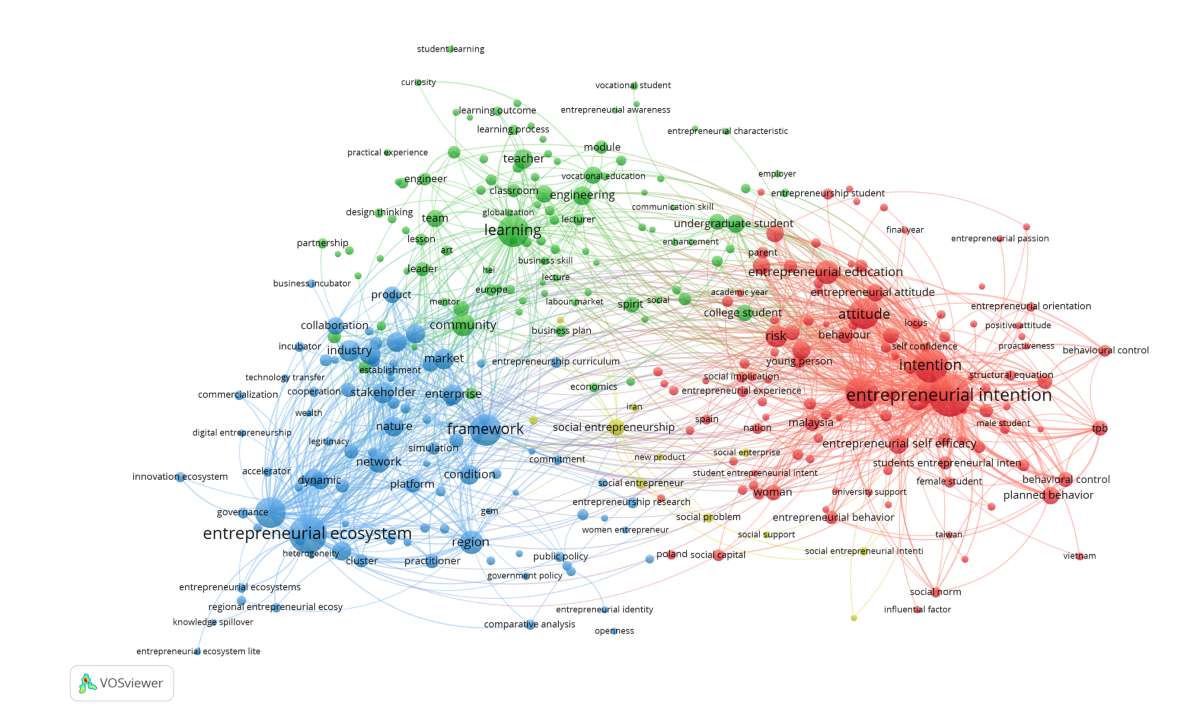
VOSviewer Bibliography network visualization – Dr. Stephanus Eko Wahyudi
Temuan Utama: Celah Riset yang Besar
Temuan paling penting justru terletak pada apa yang belum diteliti. Dari pencarian kata kunci, hanya 14 artikel membahas ekosistem digital entrepreneurship, dan hanya 7 artikel membahas student startup. Bandingkan dengan 870 artikel tentang entrepreneurship education.
Peta VOSviewer juga menunjukkan digital entrepreneurship baru terhubung dengan klaster ekosistem, belum dengan klaster lainnya. Artinya, bagaimana kampus membangun ekosistem yang sehat bagi startup digital mahasiswa masih menjadi wilayah riset yang terbuka lebar.
Peneliti juga mencatat topik yang perlu digali lebih jauh: dukungan dan latar belakang keluarga, experiential learning, magang, akselerator, serta tata kelola ekosistem. Tren ke depan mengarah pada social entrepreneurship, startup, wilayah, klaster, dan peran kampus.
Mengapa Ini Penting bagi Calon Mahasiswa?
Penelitian ini menegaskan satu hal: kampus memegang peran kunci dalam melahirkan entrepreneur digital. Mahasiswa punya ambisi tinggi, latar belakang beragam, dan beban finansial yang relatif ringan — kondisi ideal untuk memulai usaha.
Di UC, gagasan ini tidak berhenti di jurnal. Dengan semangat Creating World Class Entrepreneurs, entrepreneurship menjadi bagian dari perjalanan belajar mahasiswa di berbagai program studi. Dosen yang meneliti ekosistem startup juga mengajar langsung di kelas, sehingga mahasiswa belajar dari praktik sekaligus riset terkini.
Untuk Peneliti: Rujuk Paper Ini
Bagi akademisi dan mahasiswa tingkat akhir yang meneliti entrepreneurship education, student startup, atau ekosistem digital entrepreneurship, paper ini menyediakan peta literatur 2015–2021 yang siap dijadikan landasan. Paper dapat diunduh gratis (open access) di halaman artikel JEE, lengkap dengan format sitasi APA, IEEE, BibTeX, dan RIS untuk Mendeley/Zotero. DOI: 10.37715/jee.v10i2.2222.
Ingin menjadi bagian dari ekosistem yang melahirkan entrepreneur digital? Temukan program studi yang sesuai di Universitas Ciputra Surabaya dan mulai langkahmu di sini.

Student Innovation and Research Trends
Why Digital Entrepreneurship Ecosystems in Universities Need More Study
Google, Facebook, and Amazon all began as ideas from young founders, many of them growing up near a university campus. So how much has academic research really explored the way universities can produce digital startups?
That question was taken up by Stephanus Eko Wahyudi, a lecturer in the Informatics Study Program at Universitas Ciputra (UC) Surabaya, together with Imam Baihaqi and Niniet Indah Arvitrida of Institut Teknologi Sepuluh Nopember (ITS). Their study, “Research Trends in Higher Education Digital Entrepreneurship Ecosystems: A Bibliometric Analysis”, was published on 23 November 2021 in Jurnal Entrepreneur dan Entrepreneurship (JEE), Vol. 10, No. 2.
Mapping More Than 2,000 Studies
The team searched the Scopus database for papers published from 2015 to 2021, using keywords such as entrepreneurship education, student startup, and entrepreneur ecosystem. They found 2,178 cited articles with 23,862 citations in total. After merging duplicates, 2,023 articles were analyzed with Publish or Perish, Mendeley, and VOSviewer.
From thousands of terms, the researchers selected 321 key terms that form four major research clusters:
- Entrepreneurial intention (116 terms) – students’ intention to become entrepreneurs, linked to attitude, risk, and education.
- Learning (102 terms) – teaching, competence, teamwork, and the entrepreneurial mindset.
- Entrepreneurial ecosystem (92 terms) – networks, industry, stakeholders, and collaboration.
- Social entrepreneurship (11 terms) – small, yet connected to all three other clusters.
Key Finding: A Wide Research Gap
The most important finding is what has not yet been studied. Only 14 articles addressed digital entrepreneurship ecosystems, and only 7 focused on student startups — compared with 870 on entrepreneurship education.
The VOSviewer map also shows that digital entrepreneurship links only to the ecosystem cluster, not to the others. In other words, how universities can build healthy ecosystems for student digital startups remains a wide-open field.
The authors also highlight topics that deserve deeper study: family support and background, experiential learning, internships, accelerators, and ecosystem governance. Future research is trending toward social entrepreneurship, startups, regions, clusters, and the role of colleges.
Why It Matters for Future Students
The study underlines one point: universities play a key role in producing digital entrepreneurs. Students bring high ambition, diverse backgrounds, and relatively few financial burdens — ideal conditions to start a venture.
At UC, this idea goes beyond the journal page. Guided by the spirit of Creating World Class Entrepreneurs, entrepreneurship is part of the learning journey across study programs. Lecturers who research startup ecosystems also teach in the classroom, so students learn from both practice and current research.
For Researchers: Cite This Paper
For academics and final-year students researching entrepreneurship education, student startups, or digital entrepreneurship ecosystems, this paper offers a ready-made literature map for 2015–2021. It is free to download (open access) on the JEE article page, which also provides APA, IEEE, BibTeX, and RIS citation formats for Mendeley/Zotero. DOI: 10.37715/jee.v10i2.2222.
Ready to join an ecosystem that grows digital entrepreneurs? Explore the study programs at Universitas Ciputra Surabaya and take your first step here.